
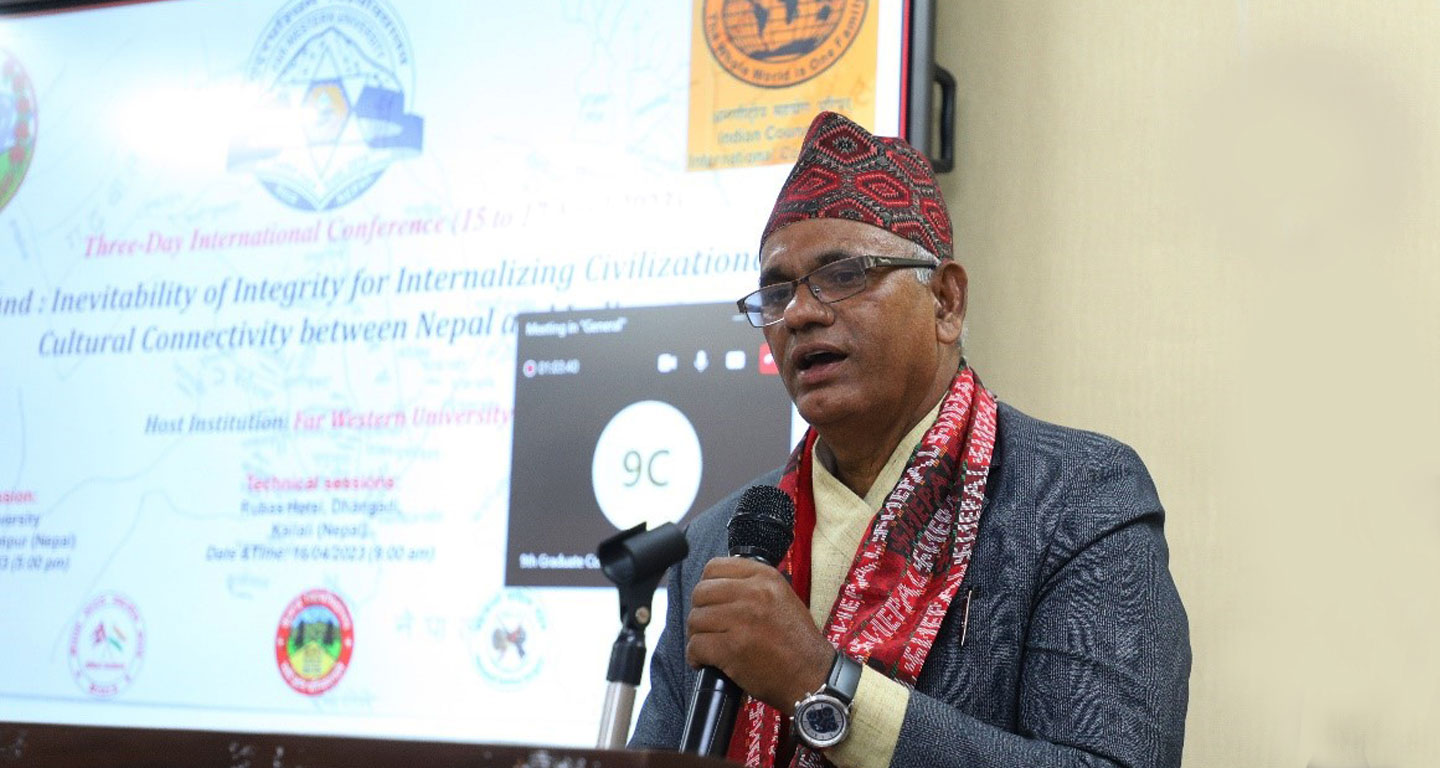
Respected President of the Ceremony, Honorable Kamal Shah, Chief Minister of Sudurpaschim Province, Nepal; Ministers of Sudurpaschim Province; Members of the Federal Parliament of Nepal; Members of the Provincial Assembly of Sudurpaschim Province; my dear friends from India; Respected Mr. Shyam Parande, Vice Chancellor of Shovan Singh Jeena University; Prof. Dr. Narendra Singh Bhandari; Prof. Dr. Vasudha Pandey from Delhi University; our friend Dr. Shah from Kumaun University; and all my friends from our university attending this seminar,
It gives me immense pleasure to join this seminar on Manaskhanda Studies, focusing on the shared heritage of our neighboring countries. I warmly welcome all the delegates and others present at this significant event.
The history of Raika, the dynasty of Sudurpaschim, Doti, is deeply explored in the scholarly works compiled by Gunakar Joshi, the Royal Poet and bookkeeper of King Jagatipal (Trailokyapal) of Doti. Since the state was founded in Saka 1235 Falgun, Suklapaksha Dwadashi Tithi, this tradition has been carried on by his progenies as the Bayal (bookkeeper) Raj-Guru. I extend a warm welcome to you all at the Farwestern Gateway of Nepal in Bheemdatta Nagar. We take immense pride in organizing this conference, which symbolizes the confluence of ‘Kali Wara’ and ‘Kali Para,’ the Trans-Kali border relatives.
Before the emergence of nation-states, the Empire of Raika Rulers of Doti governed both Sudurpaschim and Uttarakhand in India. Our kinship relations, shared history, culture, and archaeology were gifts from the Katyuri’s and their progenies, the Raikas. Later, the Chand rulers continued these traditions.
Despite belonging to two different countries, we share similarities in our languages, cultural values, ritual practices, and socio-economic conditions. Minor differences in language pronunciation may create some challenges, but our aspirations and feelings can be understood as we belong to the same socio-cultural roots. We do not need to prioritize English, as we can communicate in our native languages—Dutyali, Kumaoni, or Garhwali.
This episode of the Himalayan Folklore Summit is the second edition hosted by Sovan Singh Jeena University, where I committed to organizing this seminar in Mahendranagar, Kanchanpur. This event is in collaboration with the Sudurpaschim Province Government, Mahakali Sahitya Sangam, Sudurpaschim University, Sovan Singh Jeena University in Almora, Antar Rashtriya Sahayog Parishad (ARSP) India, Rishihood University Sonipat, Haryana, and Nepal Bharat Sahayog Munch. I express my gratitude to all stakeholders involved in making this event a grand success!
Studying the history of Medieval Doti also requires examining the civilizational Manaskhand, a region where Veda Vyas and Maharishi Parshuram (Jamadagnya) had their hermitages. Sudurpaschim is the land of Saket Dham, where Lord Vishnu resides on Seshanaga at Vishnu Dham Temple in Bhimdatta Municipality, Kanchanpur District. Our kinship relations are further exemplified by Vice Chancellor Prof. Dr. Narendra Bhandari’s ancestral village and deities in Tallo Sorad of Baitadi District, near Rodi Dewal.
The cross-border kinship relation has existed for a long time. For instance, Shree Maharajadhiraj Raika Bhupati Shahi’s (Malla’s) princess was married to Kalyan Chand, the king of Kumaon, during his regime. Udaya Dev (Uddott Chand) of Doti erected temples in Patan of Baitadi and Almora District of Uttarakhand, named Uddottchandreshwor Mahadeva at Nandadevi Temple Yard. These similarities in local deities remind us of our shared history, culture, and temple architecture.
I previously sang an epithet that mentions the fame and valor of historic heroes who displayed bravery in battlefields or sacrificed their lives. The bards of Maula Rani (Jiya Rani), Bhiyan Kathayat – Chhyan Kathayat, Chanifa Rawal, Kalo Bhandari Narusa Dhauni, Narad Paneru, Bika Paneru, Dusha Bhandari, Sangram Singh Karki, Kisa Bista, Piri Bohara, Rupa Dev Shahi, Madhuwa Auji, and others are sung throughout both cross-borders. This oral tradition continues today as a tangible and intangible cultural heritage in both neighborhoods.
Our cultural traditions, such as Jagar, Dhola, Fag, Sagun, Dhusko, Chachari, Nyauli, Baira, Thadi Bhaka, Chait, Jhoda, Dhamari, Thadokhel, Bhuwa Bharso, Deuda, Bhangnola, Bhagaling, and celebratory songs like Holy and Bhailo songs and Bhada (Bharat/Hudke Boul), Sajewali, Bhalaulo, and Nawadhi, are widely performed as tangible and intangible practices. Additionally, we share similar festivals such as Bagwal, Gaganaan (Makar Sankranti), Devi Jatras, and Gaura Astami (Aathaun). The instruments played by local drummers, the cuisine, beverages, and agricultural equipment are also similar. Historical trading systems like Gamgya Trade with Tibet, Aadat Trade System with Kumauni Traders, and Mahajani Trade System prevailed in cross-border territories.
When we study our society and culture, we observe remnants in the cultural and ritual practices in our temples. Similar castes and creeds such as Pandey, Bhatta, Rawal, Bhandari, Dashaudi Bisht, Paneru, Deuba (Deupa), Upreti, Pathak, Tamata, Lohar, Parki, Labad, Sarki, Agari, Sauka, Tharu, Sahu, Sethi, Dhami, Negi, Giri, Puri, Bharati, and Sanyashi are found across both borders, often migrating from one place to another. Migration patterns, civilization, architecture, shared history, archaeology, arts, and artifacts connect us across different eras.
Occupational castes related to iron, copper, and gold ores developed specific skills, known locally as Agar. Coppersmiths were known as Tamata, blacksmiths as Lohar, and miners as Agari. These workers were oppressed by landlords and categorized as oppressed castes. Tax collectors were named according to their duties—Pahari for guards, Parki for weavers of bamboo and leaf products, Negi for tax collectors, Bhandari for storekeepers, Syanjwal for royal treasurers, Sahu, Sethi, and Radhgali for traders, and inscriptionists of copperplates issued by the king.
The traditional art developed by the Sahu caste, known as Alpan, includes Jyoti Matrika Patta, Barbooda, Mahalaxmi Chauki, Bhitti Chitra (Wall Art), Vidhna Niwaran Chakra, and Dikara. These historical, cultural, kinship, and archaeological connections necessitate strengthening our cross-border relations.
Our relationship has been progressing for ages. Bhumiraj, also known as Dogada, is a local deity who founded Shaivism and Shaktism in northeast India and the Doti Empire. Dogada Publication House exists in Garhwal, while Dogada Kedar (Bhumiraj/Bhudeva) and Dogada Rural Municipality are in Baitadi District. Dogada is worshipped in adjoining cross-borders of Sudur Paschim province and Uttarakhand, India. In Dadeldhura District, we have the village of Sighram in the name of Ashanti Dev.
Sitting here is Hon. Prakash Deuba, the nephew of our former Hon. Rt. Prime Minister Mr. Sher Bahadur Deuba. His village, Ruwa Khola, is named after the local deity Assigram as Assigram Municipality, the land of Asanti Dev (Assim Kedar).
The Manaskhand region, starting from Nandaparvat to Kakagiri, connects us. People from the Nandadevi range are here, and we have Budi Nanda. Our Finance Minister, Hon. Naresh Bahadur Shahi’s village is in Swami Kartika Rural Municipality across the Karnali river. Recently, I visited the entire villages of Swami Kartika Rural Municipality. Swami Kartika’s temples are rare in north India, but we have a few in our province in Bajhang, Bajura, and Kailali District. Swami Kartika, also known as Mohanyal, links Doti’s cultural heritage with Karnali province and Uttarakhand, India. The ballads sung in Swami Kartika Rural Municipality mention Doti’s connections with Karnali, singing “Gairi Doti Chalo Chalyo Rata Sila Ditha” (Rata Sila refers to a place in Swami Kartika Municipality of Bajura District across the east bank of Karnali river connected with Karnali Province). This links Doti’s cultural heritage with Karnali province and Uttarakhand, forming a civilizational hub of Katyuri Civilization and linking Manaskhand, Kedarkhand, and Himawatkhand (Nepal Khand) of Skandhapurana.
Given these facts, there is no doubt that Uttarakhand (India), Sudurpaschim, and Karnali provinces of Nepal form a semi-cultural heritage. The similarities in linguistics, shared history, culture, archaeology, kinship relations, art, artifacts, and anthropological facts prove that our relations are deeply rooted and cannot be uprooted by contemporary international boundaries. We need to strengthen cross-border relations through people-to-people exchange programs, university exchange programs, and forming people’s friendship forums to enhance our socio-cultural ties. Diplomatic disputes between governments should be resolved through bilateral diplomatic dialogues. Collective studies and research should be conducted by cross-border universities to explore our natural and cultural biodiversity for mutual benefit. The Himalayan Folklore Summit, with the exchange of heritage, literature, art, artifacts, and architectural studies, should be organized regularly. Both countries’ universities should have Folklore Departments, including relevant courses in higher studies to bank, explore, and use indigenous knowledge for the people’s prosperity. The governments of Sudurpaschim and Uttarakhand should work together to make both provinces prosperous and their people happy.
I wish for the grand success of this event!
Thank you!